How to Improve Customer Experience with API Integrations

Customer experience (CX) has become a serious lever for new revenue. In crowded markets, a more delightful interaction can sway decisions long before price or product features enter the picture. About 58% of consumers chose a company in their most recent interaction because it offered a better experience than its competitors.
And yet, CX budgets are getting harder to defend. Consumer loyalty is more fragile. Economic uncertainty is reshaping spending habits, and many companies still struggle to connect CX initiatives to measurable returns. Around 2 in 5 leaders say they struggle to demonstrate the value of their CX investments — a tendency that puts ambitious transformation projects uncomfortably close to the chopping block.
With budgets under pressure, many are now looking into low-cost and high-reward digital CX initiatives — and application programming interfaces (APIs) offer just that. APIs allow businesses to connect existing systems, pull in specialist capabilities, and improve customer journeys without rebuilding their technology stack from scratch.
This post analyzes how companies across five industries are using APIs to remove friction from customer experiences, while improving the operational systems behind them.
Table of Contents
The Primer: How API Integrations Elevate Customer Experience
An application programming interface (API) set of codified rules that enable data exchanges and the use of functionality between different software.
The best way to think about APIs is as connective tissue between customer-facing apps, internal systems, and external data providers. They help businesses add useful capabilities without rebuilding every part of their technology stack from scratch.
For example, when a property research platform shows nearby schools or supermarkets, it usually pulls data from a third-party through an API, rather than implements its own mapping system. Primarily, because it’s faster and cheaper to do the former.
Depending on the use case, API integrations can help companies:
- Create a unified customer view. Data from sales, support, billing, and product systems can flow into one customer profile, giving teams more context at each touchpoint.
- Enrich customer data. Third-party sources can add more details about your consumers — from their demographics to transaction histories, location data, or identity checks.
- Deliver more personalized experiences. Businesses can use richer datasets and live signals to tailor recommendations, alerts, pricing, or service options.
- Reduce manual steps. APIs can automate tasks that traditionally required screen switching, e.g., document verification, payment initiation, lead routing, or inventory updates.
- Connect legacy systems. Older platforms often contain valuable data but cannot be exposed externally due to security considerations or scalability issues. APIs provide a practical way to access data and/or features within them while larger modernization work is underway.
The beauty of APIs is that they keep technical plumbing mostly out of sight. They allow customers to stay within the app while using functionality from other connected systems. So their experience feels faster, richer, and less fragmented.
5 Cross-Industry Examples of API Usage to Deliver Better CX
APIs create value where customer journeys often start to fray: between systems, channels, and data sources.
The next five examples show how companies across sectors use API integrations to create more joined-up and delightful customer journeys.
Finance: Account aggregation
Most customers no longer keep their financial lives neatly contained within one bank. A current account may sit with a traditional provider, while savings, investments, and credit products live with a mix of FinTech providers.
In the third quarter, of 52% of checking accounts were additional accounts. Among customers opening an additional or replacement account, 72% chose a different provider from their existing primary financial institution.
J.D. Power
Account aggregation APIs help consolidate the now-scattered financial data. With the customer’s permission, an application can connect to multiple financial institutions and retrieve account data through a shared interface. So that they get a consolidated view of their finances without requiring banks to maintain separate point-to-point integrations with every provider.
Depending on the API and the customer’s consent, aggregation APIs can surface:
- Account balances
- Categorized expenses
- Normalized merchant names
- Recent trades
- Historical records
Mastercard’s account aggregation API, for example, can retrieve up to two years of transaction and account history through a one-time pull.
For customers, the immediate benefit is convenience. Instead of logging into several apps, they can review spending, balances, or their net worth from one dashboard. Almost 60% of investors strongly agreed that a portal with account aggregation saves time.
A richer view into customers also creates more room for personalization. Over half of consumers expect greater personalization from their finance-related mobile apps than they currently get. A fuller view into customer financial lives could help banks deliver that.
The same data can also support financial coaching. A J.D. Power survey says consumers want short, actionable guidance: 26% want quick tips to improve their financial situation, while 25% are looking for help with emergency savings, and 23% want advice on staying within budget. Account aggregation can power tools for expense management, subscription tracking, or automated budgeting.
For banks that are losing footing with their customers, aggregation can help stay useful and relevant (and thus profitable). It can help them identify customer needs earlier and respond with better-timed products. Spending patterns may indicate that a customer needs a savings tool. Cash-flow signals may suggest a more suitable credit option or an overdraft buffer.
Permissioned transaction histories can also improve lending decisions. They give lenders a more current view of income, outgoings, and repayment capacity. This can support more accurate underwriting and help assess applicants with limited conventional credit histories.
More and more banks are paying attention to these opportunities. Over 90% use or plan to use APIs to generate additional revenue from existing customers.
Case: Streamlined Lending Decisions at La Banque Postale
The French La Banque Postale has recently developed an open banking process that allows applicants to consent to sharing bank account data through PSD2 APIs. The internal models then analyze balances, cash flows, and account incidents to assess credit risk.
Around 50% of its clients have already authorized access to their banking data for underwriting. This way, credit applicants now need to provide fewer supporting documents and receive decisions faster. Back-office teams also spend less time manually reviewing bank statements because the system surfaces the most relevant behavioral signals. Authentication requirements and source-bank data integrity also help reduce fraud risk.
Real Estate: Better Property Research Experience
Buying a home requires an unusual amount of detective work. Apart from comparing property values, buyers also want to check the neighborhood, nearby schools, commerce options, and community time before they commit to a viewing.
55% of buyers consider finding the right property the most difficult step in the home-buying process.
National Association of Realtors 2025 Survey
That research can quickly become a tab-management exercise. Listing portals cover the property itself, while school data, local amenities, maps, and public records often sit elsewhere. A fragmented research journey adds friction to a decision that already carries plenty of it.
Property-data APIs help bring the pieces together. A real estate platform can pull information from specialist providers and surface it alongside the listing, giving buyers a clearer picture without sending them across several websites.
Depending on the integration, a listing platform can add ownership records, tax information, building characteristics, prior sales, mortgage history, or automated valuation estimates. ATTOM, for example, provides property-centric data covering more than 160 million US properties.
Location data is another handy lever for customers’ property research journeys. Among buyers who used the internet during their home search, 35% rated neighborhood information as very useful, and 30% said the same about interactive maps.
Even better news? The same APIs can make agents more effective.
Property searches often involve a large amount of manual preparation, especially when data sits across MLS systems, public-record databases, and separate location tools.
A connected platform gives agents a fuller view of each listing before a client call. Sales history and property characteristics can support more grounded pricing conversations. Neighborhood preferences and commuting constraints can also help agents produce more relevant shortlists, reducing the number of viewings that are unlikely to go anywhere.
APIs also improve timing. Listing feeds can trigger alerts when a suitable property enters the market or changes price.
Case: Google Maps Integration for a Real Estate Platform
Edvantis has recently helped a real estate company implement a set of Google Maps Platform APIs to make property research more intuitive.
The Maps JavaScript API allowed the platform to display listings on an interactive map and add custom interface components on top of it. Buyers could explore properties spatially and understand how each option fits into the surrounding area.
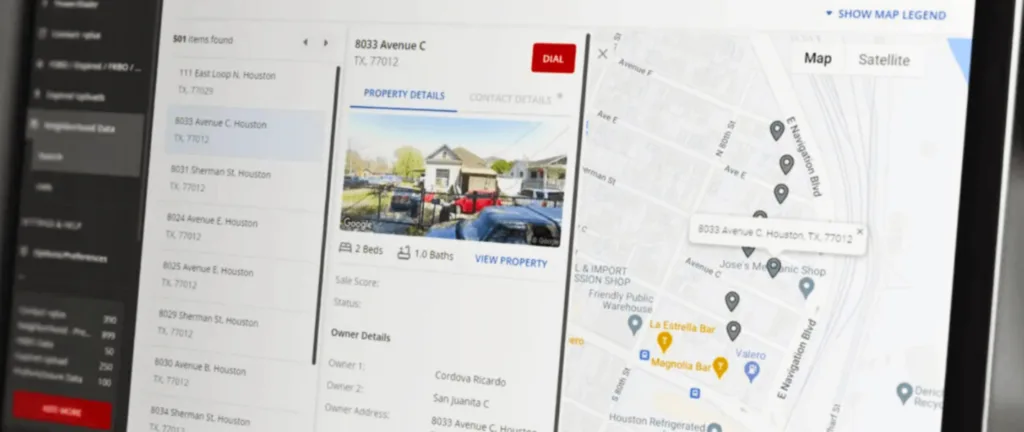
The integration also used Google Street View to provide ground-level visual context from a property address. Buyers could access thumbnail previews and explore nearby buildings, roads, and the wider environment before deciding whether a listing deserved a closer look.
Behind the scenes, the Geocoding API converted property addresses into precise coordinates. That supported accurate map markers and location-based searches, such as browsing homes within a preferred area. It also helped standardize location data across the platform, which matters once listings start arriving from multiple sources.
None of these features radically reinvent property search. But they removed repetitive frustrations buyers faced by presenting useful information where the customer already needs it.
Retail: Real-Time Inventory Visibility
Omni-channel shopping is now the norm for most consumers. They expect seamless transition between online and offline experiences, in particular when it comes to product availability.
- In the US, 73% of B2C consumers expect an on-the-moment digitally updated inventory when making retail purchases.
- In the UK, 40% of B2B buyers cite lack of transparency around stock and delivery dates as their top frustration.
But for retailers, delivering an accurate answer can become surprisingly complicated as this data is often siloed across multiple retail systems — ecommerce platforms, point-of-sale systems, warehouse tools, and order-management software.
Inventory APIs help retailers link up that data to monitor stock, based on real-time data on how products are sold, returned, transferred, or replenished. For instance, Salesforce’s omnichannel inventory APIs provide near-real-time availability data at the location level and manage reservations across fulfillment channels.
Inventory visibility also protects cash flow. IHL Group estimated that out-of-stocks and overstocks cost retailers $1.73 trillion globally each year. It is an awkward pairing. One problem loses the sale, while the other locks cash into products that may eventually require markdowns.
APIs help keep different data from different retail systems synchronized and universally visible, so your teams make more grounded decisions about replenishment and allocation. Customers then gain a dependable shopping experience. And finance teams — fewer reasons to stare unhappily at excess inventory reports.
Case: Predictive Inventory Management at Migros
Swiss retailer Migros runs a network spanning hundreds of physical stores and several ecommerce channels. Across it, tracking inventory levels for some 30,000 SKUs was no small feat.
To access more working capital while keeping the shelves well stocked, Migros decided to implement a real-time inventory forecasting solution. The new system consolidates data from multiple sources, while accounting for category-specific requirements, including perishables and seasonal goods. It also coordinates replenishment across suppliers, warehouses, and channels.
The system now makes over 20 million inventory decisions each day for Migros, which helped the company:
- Reduce inventory days by 11%, freeing up working capital
- Improve product availability by 1.7%,
- Recover 1.3% of lost sales due to stockouts
The percentage changes may look modest at first glance. But across 30,000 SKUs, that results in thousands of inventory costs saved daily.
Contact Centers: Better Lead Management
Contact centers feel the strongest pressure to elevate CX and operating efficiency as query volume grows and staffing issues persist. But that becomes difficult when lead sources sit apart from the systems agents use every day.
APIs can help connect data from various advertising and messaging channels with CRM records and deliver those insights to contact center agents. Or build automation scenarios to reduce menial work. For example, when a new enquiry arrives, the integration can create or update the CRM record and route the lead into the appropriate workflow.
The first improvement APIs enable is speed. Agents receive the enquiry while the customer is still interested, rather than discovering it after the useful window has narrowed.
Predictive routing tools can use customer and interaction data to match an enquiry with an agent who is better suited to handle it. Genesys reports that organizations using its predictive routing typically see:
- Handle time reductions of 5% to 15%.
- Customer satisfaction improvements of 3% to 10%.
- First-contact resolution increases of 2% to 5%.
The second improvement is a better context. A basic form submission may contain little beyond a name, contact details, and a short message. API integrations can enrich the bare-bones records with browsing behavior, prior conversations, account history, or campaign source data before the lead reaches an agent. For example, if you connect Twilio Segment with HubSpot, your teams can evaluate all incoming leads using demographics, firmographics, and behavioural signals.
With this data at hand, your team can go after prospects with the highest likelihood of converting and personalize outreach to get to a ‘yes’ faster.
Case: Integrating PhoneBurner into the lead-management workflow
Edvantis recently helped a company build a more streamlined sales workflow with a PhoneBurner integration.
PhoneBurner combines outbound calling with CRM features, follow-up automation, and call tracking. The API integration keeps listings and lead histories synchronized with PhoneBurner. So new listings automatically move into the dialer once they are added to the source system. Teams can also trigger updates manually when needed.
This removes a routine but costly source of friction. Agents no longer need to import records repeatedly or wonder whether their calling lists reflect the latest inventory. Their workflows stay aligned with changes happening elsewhere in the platform.
The integration also synchronizes listing-related history, including notes and interaction summaries. Agents can see how a lead has engaged with a specific listing before starting the call. That context makes outreach more relevant and reduces the chance of asking customers to repeat information they have already provided.
Insurance: Faster Claims Processing
Just like in other sectors, customer expectations have shifted dramatically in the insurance sector. Particularly when they are dealing with a damaged home, a car accident, or an unexpected expense.
Globally, 52% to 63% of customers stated that a quick response is one of the top three expectations they have after making a claim.
Sollers Consulting
How fast are we talking? The majority (82%) expect payouts within five days. And if they’re not happy with the claims experience, most will switch insurers.
Those expectations leave little room for slow handoffs between often disconnected systems — policy administration platform, claims management system, repair networks, external payment processors, etc.
APIs help those systems exchange information as the claim progresses. When a customer reports a loss, an API automatically pulls policy details, confirms coverage, and passes the case into the claims platform. Once the required checks are complete, another API can initiate payment and update the customer-facing app automatically with the resolution.
External data from APIs can also strengthen the first assessment. Property claims may depend on weather conditions at a specific address. Verisk Benchmark API, for example, provides location-specific analysis for hail, wind, lightning, and hurricane wind events. Similarly, vehicle claims can draw on repair estimates or telematics data.
That reduces guesswork during the initial assessment and unnecessary inspections. Faster processing works best when the insurer can automate the routine checks without cutting corners on the complicated ones.
Case: AXA Brazil Delivers Faster Roadside Assistance
AXA Brazil recently redesigned its roadside assistance offering, using data from the national Open Insurance initiative. The insurer optimized the claims process by connecting several internal systems with partner services and regulatory infrastructure using IBM webMethods Hybrid Integration. A consolidated data layer supports policy and coverage checks, while shared API patterns reduce the need for isolated, one-off integrations.
The new system:
- Processed over 40 million transactions over recent years with availability approaching 99.99%.
- Reduced response times for real-time quoting and roadside assistance.
- Streamlined partner onboarding through reusable integration components.
The case makes a useful distinction. Claims processing speed depends partly on the interface the customer sees. Reliability underneath carries equal weight. When a driver is waiting at the side of the road, a beautifully designed app has limited value if the partner integrations start twiddling their thumbs.
Conclusion
Customers rarely think about the “technical plumbing” behind a smooth experience. Instead, they notice when a banking app gives them better financial advice or a property platform offers more criteria for research.
APIs create a strong, but oftentimes invisible CX value. They connect fragmented systems, bring useful data into the customer journey, and automate routine handoffs that otherwise slow everything down. The customer-facing result may look deceptively simple. Delivering that simplicity usually requires serious system integration work behind the scenes — something we do at Edvantis.
We’re helping businesses across domains consolidate fragmented systems to break down cross-functional data silos and embed extra capabilities into key workflows to support both your workforce and your customers.
Contact us to learn more about how your business can use API integrations to improve customer experience.