7 Microservices Architecture Patterns for 2026

Microservices have been a mainstream application architecture pattern for more than a decade. The core idea of splitting services into smaller components still holds, but new challenges have emerged.
Service-to-service communication, distributed data management, security controls, and infrastructure overhead are among the top concerns for larger microservices estates. At the same time, engineering teams are under pressure to control cloud costs and further evolve the system design for AI-enabled applications.
These factors are pushing companies towards a more selective approach to microservices architecture design. Some are consolidating services into modular monoliths. Others are introducing event-driven communication, serverless components, or stronger patterns for distributed transactions and service security.
To get you up to date, Edvantis cloud engineering team prepared a refresher on microservices architecture patterns – their advantages and implementation tradeoffs.
Table of Contents
Proven Microservices Architecture Patterns for 2026
Microservices design has become more pragmatic. Most teams are shifting towards reducing unnecessary distribution, improving service boundaries, and applying infrastructure patterns only where they support clear operating requirements.
The following microservices architecture patterns now balance independence with restraint, leading to better scalability and cloud economics.
Modular Monoliths
Microservices introduce trade-offs in distributed system management. Service boundaries can add more network calls, latency, infrastructure, and monitoring complexity.
A modular monolith architecture keeps much of the logical service separation, but with fewer overheads. The application is divided into clearly bounded modules, usually around business capabilities such as payments or inventory.
Yet, the modules remain part of one deployable application. So you can develop and test new components with a high degree of independence while keeping communication inside the same process.
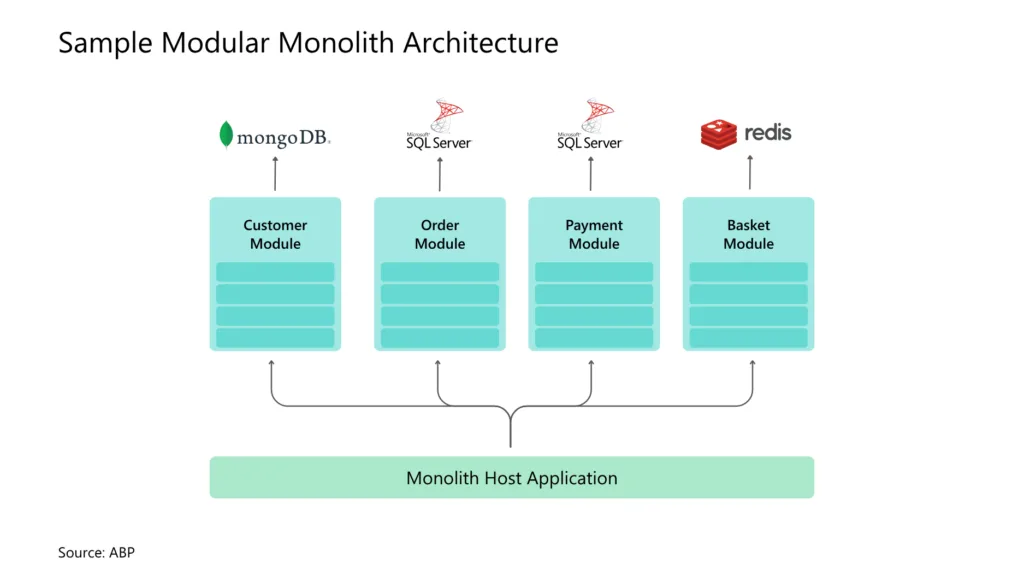
Effectively, you get some of the major architectural benefits of microservices:
- Explicit boundaries
- Modular ownership
- Reduced code coupling
- Easier future extraction
But without immediately paying for:
- Higher volume network calls
- Distributed transactions
- Service discovery
- Cross-service observability;
- Complex deployment infrastructure.
This approach speaks to a growing cohort of companies: 42% are consolidating microservices into larger deployable units, including partial consolidation and broader moves towards monolithic architectures.
Amazon, for instance, recently merged several microservices back into a single-process modular monolith for its Prime Video service. The rationale? Reduce the number of network calls, orchestration, and debugging, plus scale the monitoring pipeline. After the consolidation, the Video Quality Analysis team reported a 90% infrastructure cost reduction and improved performance for the merged workloads.
The advantage of modular monoliths is that they co-exist with other system architecture patterns. Current AWS guidance emphasises that modular monoliths can serve some domains while independently deployed services handle areas that need separate scaling or stronger isolation. So a module can remain inside a monolith app until its scaling, technology, or organizational requirements justify extracting it into a separate microservice.
That appeared to be the case for Shopify, which decided to evolve its legacy Rails monolith architecture into a modular monolith. They were not ready to give up existing deployment simplicity, yet wanted to:
- Parallelize teamwork across new features for faster releases
- Enable better scalability for traffic peak events
Modular monolith architecture allowed Shopify to preserve a single deployable platform, but with cleaner boundaries between components and tooling. It can now process 30TB/minute of data without adding more operational tax for the teams.
Modular monolith offers a good middle ground: Architectural separation where it helps, with distributed infrastructure introduced only where the operating requirements justify it.
Bounded-Context Services
Defining service boundaries is one of microservices’ trickiest design choices. Poor boundaries create unnecessary dependencies and frequent cross-service changes.
To avoid that, we recommend using a bounded-context service approach.
A bounded-context service organizes each microservice around a well-defined business capability rather than a technical function. So you have a microservice for “payments” or “product analytics”, instead of one for “a database service” or “a validation service”. The goal is for each service to own the full logic and data required for its domain.
A bounded-context service is particularly useful for migration from legacy systems to microservices.
Large monoliths rarely map cleanly into dozens of independent services, so you first need to understand where business responsibilities naturally separate. Extracting services too early can create boundaries that later prove difficult and costly to maintain.
To avoid that, we recommend using the Strangler Fig pattern.
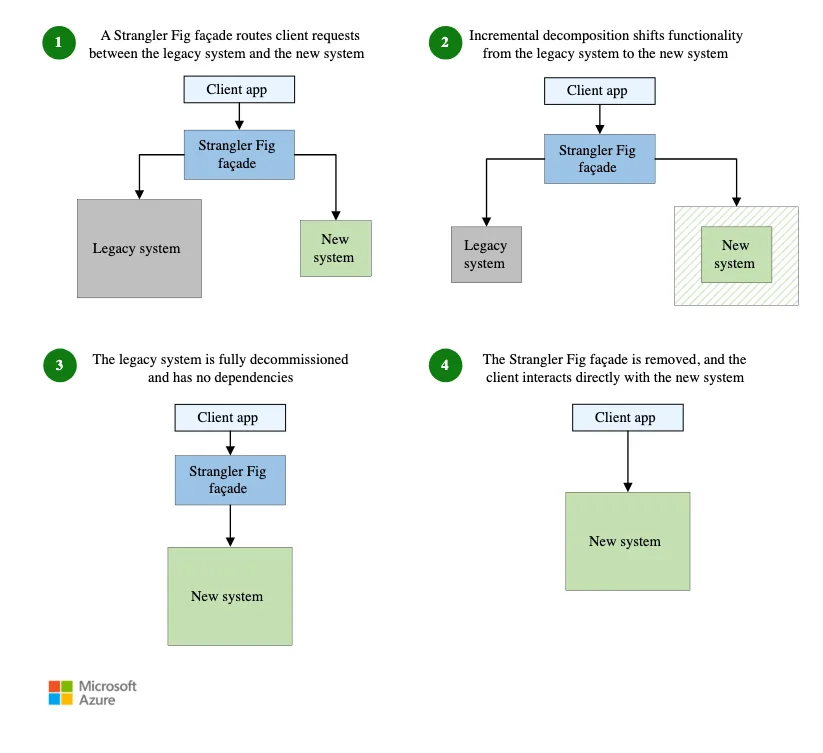
Instead of rebuilding the entire application at once, individual business capabilities are extracted into new services while the legacy application continues operating. A routing layer then directs requests to either the existing system or the new service until the older functionality can sunset.
This way, you reduce migration risk, and the team can:
- Release features while modernization is underway
- Validate each service boundary with production workloads
- Limit the impact of failures to a smaller area.
Also, well-defined contexts can reduce coupling because each service owns a narrower set of responsibilities and can evolve with fewer dependencies.
Netflix applied this logic when rebuilding its video-processing pipeline on the Cosmos platform. The team analyzed individual processing steps and separated distinct capabilities into dedicated services, like the Video Encoding Service and Video Quality Service.
In the process, they realized some services became too granular: They designed separate encoding services for different codec formats. So they consolidated these to avoid overhead, keeping one shared encoding service while preserving independently managed processing functions where separation remained useful.
Bounded contexts bring a useful constraint to the microservices development process: Split services where business responsibilities genuinely diverge, then keep the boundary only while that independence continues to justify its operational cost.
Event-Driven Microservices Architecture
Event-driven microservices architecture is recommended when workflows span multiple services, demand is uneven, or downstream processing doesn’t have to happen immediately.
For example, a successful card payment can trigger fraud screening and settlement processing independently, without holding up the customer-facing transaction flow.
In this case, one service publishes an event when something happens, while other services process that event asynchronously through a message broker or event bus.
So you get the advantages of:
- Lower direct dependencies between services. One part of the application can keep working even when another is busy, which helps avoid unnecessary slowdowns across the wider system.
- Stronger fault isolation. A problem in one service is less likely to interrupt the entire customer or operational workflow, reducing the risk of broader outages.
- Better handling of traffic spikes. Sudden increases in demand can be absorbed and processed over time, helping the system stay responsive during peak periods without overprovisioning infrastructure.
So it becomes particularly useful when workloads are long-running, arrive in bursts, or need to trigger several downstream processes. For example, a ‘new order’ event may update inventory while another service starts fulfilment. Neither process has to block the service that accepted the order.
That said, asynchronous communication introduces extra operating requirements.
Troubleshooting becomes harder because a request may pass through several queues and services before completing. Duplicate or delayed events need explicit handling. A good practice is to introduce standard specifications like AsyncAPI 3.1.0 to support event documentation and versioning.
Likewise, you’ll need to create a process for dead-letter handling — inspection and reprocessing of failed events. Alongside better observability practices to support tracing, correlation IDs, and event-level monitoring for failure management.
That said, not everything in microservices must be asynchronous, just because it’s technologically feasible. Asynchronous communication adds queues, retries, event ordering, and more complex debugging. However, if your goal is greater scalability, the approach can be worthwhile.
Spotify moved its event-delivery infrastructure from a self-managed Kafka-based stack towards Google Cloud Pub/Sub. This way, services could emit events without needing downstream systems to be available or process them immediately. Spotify’s microservices platform now handles over 8 million events per second at peak, across 500+ event types and more than 350 TB of raw event data per day.
Serverless Microservices
Not all microservices need to have a dedicated server or continuously running infrastructure. Some can make do with serverless architecture.
In this case, you deploy a service as a cloud-managed function that executes only when a pre-programmed event happens (e.g., a scheduled task is set to run).
This way, you avoid paying for compute time for infrequently run workloads. Likewise, this approach changes how services scale. A conventional service may require an entire application component to scale when demand rises. With Functions-as-a-Service (FaaS), individual functions can scale independently based on incoming traffic, so infrastructure consumption matches the actual usage better.
Serverless microservices are particularly well suited to:
- Event-driven processing
- Intermittent background tasks
- Workloads with sharp demand peaks
- Lightweight services that don’t justify constant infrastructure
From a business perspective, the main advantage of serverless architecture is cost and operating efficiency.
Cloud providers handle much of the underlying infrastructure management, so there’s less effort required for provisioning and routine server maintenance. And engineering teams can spend more time on application logic while the platform manages execution capacity.
Edvantis used this approach when modernizing a client environment with 50 separate APIs. The existing infrastructure had become difficult to manage and no longer supported the business requirements. We moved selected components to a cloud-native, serverless architecture and reorganized the supporting data flows. The company’s infrastructure hosting costs were reduced by 60%. They also gained more efficient data collection and improved data management.
Generally, you don’t have to move every service to serverless infrastructure. Long-running or compute-intensive services may remain containerized, while functions handle event processing or other workloads where rapid scaling and pay-per-use pricing offer a clearer advantage.
Zero-Trust Security
Microservices create a larger application attack surface. Hackers can exploit exposed APIs, weak service-to-service authentication, misconfigured access controls, or unpatched dependencies. So internal traffic can’t be treated as inherently trusted.
A zero-trust microservices security model addresses these gaps through extra authentication for every service interaction. Service A should be able to verify who it is, establish a secure connection, and demonstrate that it is permitted to call Service B.
Zero-trust setup:
- Reduces reliance on network location. Each request is evaluated based on who is making it and what that workload is allowed to do, rather than on its origin only.
- Supports stronger auditability. Service-to-service access becomes easier to trace because every request is tied to a verifiable workload identity.
You gain lower exposure to broad system compromise. One weak trust assumption can spread across the entire microservices estate. Zero-trust controls help contain failures and limit the blast radius.
To support zero-trust security, you should introduce workload identities alongside standard security controls such as mutual TLS, JWT-based authentication, certificate rotation, encryption, and automated security scanning in CI/CD pipelines.
To secure its microservices platform, Uber designed a workload identity platform using SPIFFE/SPIRE across a heterogeneous production environment. With it, workloads can authenticate each other independently of the network they happened to run on.
Zero trust does introduce extra operational work, especially around identity lifecycle management and certificate handling. But this overhead is often justified by lower risks. Companies with mature zero trust deployments save an average of $1.76 million per breach compared to those without it.
Saga Transactions
Microservices should own their domain data. But that makes distributed transaction processing more complex.
One single business process may span several services, but traditional ACID transactions don’t extend cleanly across multiple independent databases without introducing tight coupling or performance overhead.
A Saga design pattern addresses the issue. Each larger transaction gets split into a sequence of smaller local transactions. So each service completes its own step and then signals what should happen next. If a later step fails, the system runs a compensating action to reverse the earlier change where possible.
A typical order flow might look like this:
Create order → reserve inventory → charge payment → arrange shipment.
If the payment fails, the Saga can trigger compensating actions such as releasing the reserved inventory and cancelling the order. Your services get to keep independent data ownership while still coordinating a broader business process.
The two common implementation approaches are:
- Choreography-based Saga. Services react to events and publish new ones without a central coordinator. Services remain loosely coupled, but the workflow can become harder to trace as the number of participants grows.
- Orchestration-based Saga. A central Saga orchestrator tells each service which step to execute, and manages failure paths. Teams have clearer control over complex workflows, but the tradeoff is extra coordination.
Sagas are particularly useful where one customer or operational transaction spans multiple domains, such as payments, reservations, fulfilment, or regulated multi-stage processes.
They also make failure handling explicit. Instead of relying on a global rollback across several databases, teams define in advance what should happen when a step cannot be completed.
Mia-Platform recently implemented an orchestration-based Saga to control a sequence of local transactions. They went with an orchestrator because the workflow was expected to evolve. A central orchestrator enabled easier change management, while keeping write permissions with one actor. It also allowed participating microservices to remain independent.
For workflows where data ownership must remain distributed, Sagas provide a practical way to coordinate consistency without reintroducing a monolithic transaction model.
Service Meshes
As a microservices estate grows, service-to-service communication becomes harder to manage consistently. You’ll need to handle routing, encryption, retries, load balancing, and observability across dozens or hundreds of services, which can lead to duplicated infrastructure logic inside application code.
A service mesh moves much of that communication logic into a separate infrastructure layer, which handles common functions like traffic management or request management for all underlying microservices.
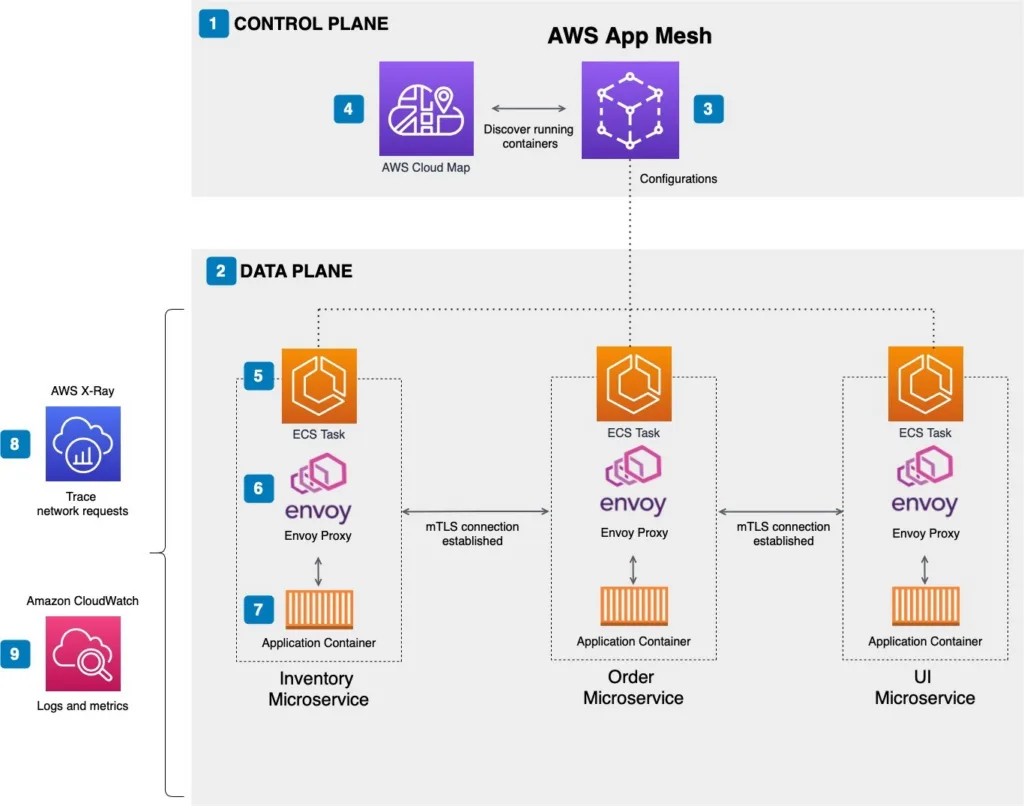
In larger distributed systems, service meshes help:
- Standardize service communication. You can apply common routing, security, and retry policies across services instead of maintaining separate implementations, which is more cumbersome.
- Improve observability. A mesh can provide consistent telemetry on service-to-service traffic, which helps teams trace latency, failures, and dependency issues.
- Enable stronger security controls. Encryption and identity policies can be enforced centrally across internal traffic, which supports the zero-trust model.
The trade-off is added platform complexity. A service mesh introduces its own control plane, runtime overhead, and debugging requirements. So the benefits depend heavily on scale and operating maturity.
Performance costs also vary by implementation. Comparative research found meaningful differences in latency and resource consumption between mesh architectures. So you’ll have to benchmark different approaches and providers against your own traffic patterns and infrastructure before standardizing the deployment.
For example, it took Mezmo six months to operationalize their service mesh technology. But once it was up and running, it secured petabytes of data each month without requiring every service team to implement mTLS independently.
A service mesh therefore makes the most sense when repeated networking and security requirements have become a platform-level problem. For smaller microservices environments, the extra layer may add more complexity than it removes.
Build for the Complexity You Actually Need
Modern microservices architectures are becoming more deliberate about where distribution adds value and where it creates avoidable overhead.
What emerged as a result are combined approaches. A modular monolith may simplify one part of the estate, while event-driven services handle asynchronous workflows elsewhere. Sagas can coordinate distributed transactions. Zero-trust controls can secure communication. Service meshes can standardize traffic management once platform complexity justifies the extra layer.
If you’re evaluating a migration from legacy systems to microservices, redesigning an existing microservices platform, or looking to reduce the operational cost of a distributed architecture, Edvantis can help assess the current environment and define a modernization approach around your technical and business constraints.
Contact us to discuss your architecture goals.