The API Economy Trends: 5 Fastest Growing Sectors for This Decade

Many companies own assets that other businesses are willing to pay for: proprietary data, domain logic, workflow automation, infrastructure access, or software capabilities built for internal use. APIs make those assets programmable and securely distributable.
For some, APIs create a new provider-side revenue stream by turning existing capabilities into products. For others, API consumption changes the economics of product development by making it possible to add payments, location intelligence, AI, network services, or cloud controls without custom-coding each capability.
Both sides form the booming API economy — a $23.8 billion market today and a $128.9 billion one by 2036, where new demand is forming quickly.
Table of Contents
Understanding the API economy
The API economy is an ecosystem where companies create application programming interfaces (APIs) to expose data, services, and digital capabilities to third parties.
APIs give companies a way to package a “capability” — a payment flow, weather dataset, fraud check, routing engine, pricing rule, or AI model — which other companies can use to augment or build their products.
Effectively, the API economy gives companies two routes into the same market:
- Become an API provider and create new revenue streams from existing products.
- Become an API consumer that uses third-party capabilities to optimize its ops and create more competitive products.
And many businesses are already using both options.
Vaisala, historically known for weather and environmental measurement equipment, now sells weather intelligence through Vaisala Xweather APIs as an extra revenue stream. HERE Technologies moved from map data into location, routing, and geocoding APIs as its core business. And Foursquare made a pivot from a consumer check-in app to a location data infrastructure company, selling geospatial and market intelligence.
The above examples are hardly edge cases. Among businesses surveyed by MuleSoft in 2025, APIs and API-related implementations now generate an average of 40% of company revenue. And this number is only expected to increase over the coming years.
So if your company owns proprietary data, specialized workflows, domain logic, infrastructure access, or repeatable software capabilities, there may be an API provider opportunity hiding in plain sight.
On the other hand, API consumption can help teams add capabilities faster to improve CX, automate operational bottlenecks, and avoid rebuilding services that already exist elsewhere by changing the economics of product development.
No matter which way you look at it, the API economy has substantial opportunities for revenue generation.
5 Fastest-Growing Sectors of The API Economy
Based on the latest API economy trends, our team has mapped five sectors where API growth looks especially promising.
For API providers, these sectors point to where demand is forming and what kinds of capabilities buyers may soon expect as programmable services. For API consumers, they show where external infrastructure can help teams move faster or lower build costs.
Network APIs
Network APIs provide on-demand, programmable access to telecom and connectivity capabilities through software interfaces — a great alternative to manual provisioning and brittle, one-off integrations.
These can include services like SIM-swap detection, number verification, device location, bandwidth adjustments, or network performance controls, among others. Many of these capabilities aren’t new. But the commercial shift comes from exposing them in a standardized way so banks, retailers, mobility platforms, media companies, and industrial operators can easily build them into their own products. And this market is growing fast.
The global network API market was valued at $1.55 billion in 2024 and is projected to reach $50.23 billion by 2033, growing at a 47.6% CAGR.
Grand View Research
The commercial opportunities of network APIs span across the following use cases:
- Fraud prevention and identity verification. APIs like SIM-swap detection or number verification can help reduce account takeover risk and make user authentication more seamless.
- Quality-on-demand APIs enable dynamic provisioning of stronger network performance when latency or reliability matters for deployed applications (e.g., in healthcare or at industrial production sites).
- Location and mobility intelligence APIs offer access to extra network-based signals to support routing, geofencing, asset tracking, and other contextual services.
- Programmable enterprise connectivity APIs allow businesses to adjust network capacity, policies, and performance based on demand rather than overbuying fixed capacity.
GSMA Open Gateway is the major industry attempt to enable programmable enterprise connectivity. The initiative aligns operators around a common API framework, with 86 operator groups, more than 300 networks, and 80% of global mobile connections represented as of March 2026. GSMA also reports more than 300 commercial instances of 20 CAMARA APIs across 65 markets.
That standardization matters because network APIs only become broadly useful when developers can avoid rebuilding integrations for every carrier and market. Ericsson recently launched a joint venture with 12 other telecom operators to sell network API software that can work across different countries and telecom networks.
Tata Communications shows the enterprise-infrastructure side of the same story. It has launched Network Fabric — a programmable network-as-a-service layer that supports on-demand control, dynamic security policies, rapid site setup, instant bandwidth changes, and network visibility. That is useful for companies dealing with uneven traffic patterns, hybrid cloud environments, or global operations where “add more capacity and hope” is a costly operating model.
Then there is the agentic AI angle, which telecoms are exploring.
Telefónica and Nokia are testing Agent-to-Agent Protocol and Model Context Protocol to help AI agents discover and consume network APIs more securely and consistently. Their stated goal is to make network capabilities easier to expose, select, and monetize through automated workflows.
Google Cloud is also collaborating with Nokia to make networks consumable by enterprise agents. Early use cases include device management, fleet management, security monitoring, identity checks, and quality controls.
For API providers, network APIs create a way to turn infrastructure advantages into programmable products. For API consumers, they offer a way to build stronger authentication, better performance, and smarter connected experiences without owning the network underneath.
Agentic Commerce APIs
Retail companies now have two distinct customer groups: the agent and the human.
Agentic commerce could account for roughly 15% to 25% of the US ecommerce sector by 2030, representing a $300 billion to $500 billion market.
Bain
Today, however, agentic shopping often gets stalled by fragmented retail tech stacks. Disparate systems often make it hard for AI agents to correctly parse product data, verify inventory statuses, and perform other commerce actions correctly.
Agentic Commerce APIs help AI assistants discover products, compare options, check availability, apply rules, authorize payments, and complete transactions through structured interfaces instead of scraping websites or guessing their way through checkout flows.
The commercial opportunities in this sector of the API economy fall into two broad camps.
- For API consumers: Retailers and brands can use these APIs to make their products discoverable across AI surfaces without rebuilding every integration from scratch.
Google’s Universal Commerce Protocol is one of the clearest examples of where this is heading. Google describes UCP as an open standard for agentic commerce that helps turn AI interactions into sales, starting with direct buying through AI Mode in Google Search and Gemini. The broader idea is to create a common language for agents, platforms, businesses, and payment providers, so each new agentic shopping surface doesn’t require another custom integration.
That standardization is the commercial story hiding inside the technical one. Fragmented commerce is annoying for developers and expensive for merchants. It becomes even more awkward when AI agents need to compare products, respect user preferences, apply payment credentials, and complete purchases without turning every transaction into a hand-built exception.
Peak Commerce takes a more direct API-product approach with its agentic commerce platform, featuring catalog APIs that return plans, pricing dimensions, entitlement bundles, and compatibility rules in machine-readable JSON. It also includes APIs for entitlement verification, policy checks, product evaluation, and transaction workflows, which make it easier to adapt retail interfaces for agentic integrations.
Agentic commerce enablement also extends further into consent, payment security, fraud controls, and clear accountability when an agent buys the wrong thing or follows the wrong instruction. Recent research around agentic payment protocols points to risks around authorization, replay attacks, and runtime verification, which suggests the security layer still has to be improved.
Still, the direction is clear enough. Agentic Commerce APIs are turning commerce from a page-based experience into a programmable transaction layer. For API providers, that opens new surfaces to monetize. For API consumers, it creates a practical question of adapting their storefronts for both human and agentic buyers.
AI Model APIs
AI model APIs give companies access to the latest models without requiring them to train, host, or operate the models themselves.
The commercial logic is straightforward. Most companies want AI features. Far fewer want the infrastructure bill, model operations burden, safety testing, latency tuning, and talent war that come with building everything from scratch. APIs turn model capabilities into something teams can consume on demand, test, and swap if they prove not to be a great fit for the selected AI use cases. Given how quickly AI stacks evolve, model APIs allow you to iterate faster and at a lower cost.
For instance, contact centers are driving the demand for AI adoption. Customer service is full of repeatable workflows, measurable outcomes, and language-heavy interactions, which makes it unusually API-friendly.
So it should come as no surprise that voice AI infrastructure is expected to grow from just $5.4 billion now to $133.33 billion by 2034. Big names like OpenAI, Mistral AI, and xAI have recently presented new models, designed specifically for real-time voice tasks and live speech-to-text use cases. Startups like ElevenLabs, Deepgram, Vapi, and Speechmatics also continue to raise the bar in speech recognition, text-to-speech, and low-latency streaming.
That said, voice AI is still far from being the perfect assistant. A recent study of production real-time voice systems found that models often act on spoken words while underweighting vocal delivery, even when tone, distress, fear, or sarcasm should change the interpretation.
Retrieval APIs are another fast-growing pocket, and arguably the less flashy one.
Enterprise AI projects often fail to stick because the model sounds fluent while the answer floats away from company knowledge. Embedding, reranking, and passage retrieval APIs help close that gap by giving models better evidence to work with.
MongoDB’s Embedding and Reranking API on Atlas, for example, offers developers serverless access to Voyage AI retrieval models inside MongoDB Atlas, while remaining database-agnostic enough to fit into other stacks. The use cases are exactly where enterprise teams are spending money: semantic search, RAG, and AI assistants grounded in company data.
Coveo’s Passage Retrieval API, in turn, can be integrated with Amazon Bedrock Agents to help LLM-powered assistants return more accurate, context-aware, and grounded responses across proprietary knowledge.
The bigger strategic point is that AI Model APIs are becoming less about “add AI” and more about choosing which intelligence layer should be bought, customized, or built. For providers, the money is increasingly in models wrapped with reliability, access controls, usage metering, governance, and domain-specific performance.
For consumers, the advantage comes from selective adoption. Using external APIs makes sense when the capability is expensive to develop or fast-evolving. But you might want to stay more skeptical if the model logic touches proprietary data, regulated decisions, or customer trust.
A solid enterprise API economy strategy in this case avoids both extremes: rebuilding the entire AI stack for sport, or outsourcing every important product judgment to a black-box endpoint.
Cloud Orchestration and Optimization APIs
A host of new APIs have emerged to help companies manage cloud infrastructure through programmable controls for resource provisioning, usage metering, spending optimization, and workload scaling — all without manually stitching every operational workflow together.
The opportunity sits in several practical use cases:
- Usage metering and billing. APIs can help users track consumption by customer, tenant, workload, API call, compute unit, or token to offer more accurate billing and pricing models.
- Dynamic scaling and provisioning. The ability to add or reduce capacity based on demand instead of overbuying fixed infrastructure is another strong attractor.
- Cost optimization. To keep cloud bills at bay, companies are looking for better ways to route workloads, enforce budgets, cache responses, and reduce unnecessary compute waste.
- AI infrastructure management. With more AI apps running in production, users seek ways to manage GPU-heavy inference workloads without forcing every team to become an infrastructure specialist.
Rafay, for instance, offers a serverless inference platform that lets teams run and scale AI models through APIs without directly managing GPUs, clusters, or runtime environments. It also includes built-in governance, multi-tenancy, and on-demand infrastructure management.
The billing angle is just as important. Rafay’s usage metering APIs are designed for GPU and NeoCloud providers that need to automate billing, showback, or chargeback models based on actual resource consumption.
Kong shows the API monetization and governance side. Its Konnect platform positions API and AI traffic management in one control layer, with capabilities for governing, observing, scaling, and monetizing APIs, agents, MCP servers, and AI traffic.
For API providers, cloud orchestration and optimization APIs create new revenue streams around infrastructure intelligence. You can sell metering, billing, autoscaling, policy enforcement, GPU orchestration, cost analytics, and AI gateway capabilities as modular services. The product is less “cloud dashboard” and more “programmable operational control.”
For API consumers, the benefit is leverage. Teams can consume orchestration APIs to control cost, automate infrastructure decisions, and manage AI workloads without rebuilding platform engineering functions from scratch. That matters when compute has become one of the few line items capable of making finance teams develop a sudden interest in architecture diagrams.
Financial APIs
Financial APIs let companies embed banking, payments, lending, treasury, identity checks, and other financial services directly into their own platforms to offer a continuous experience.
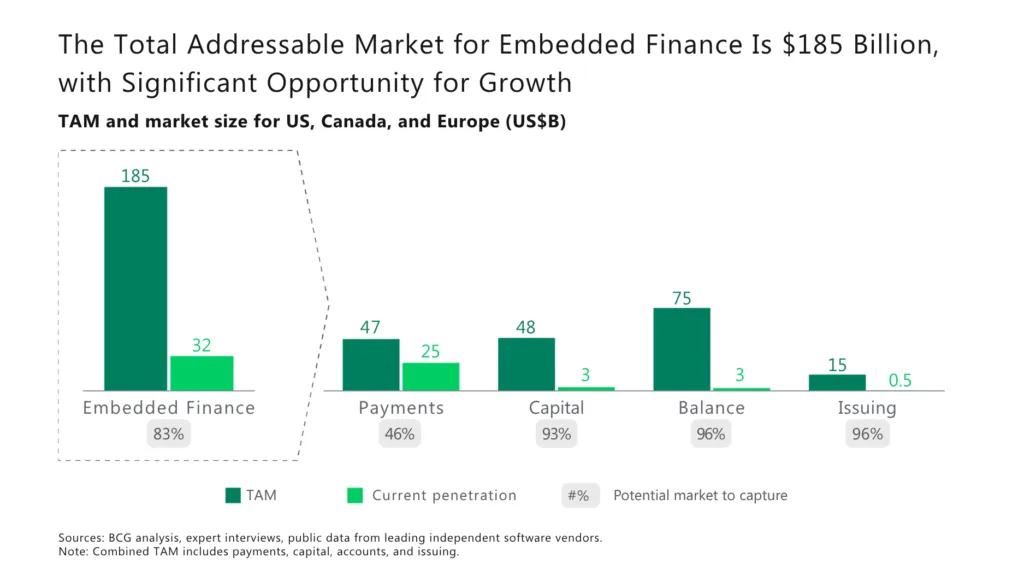
That is the basic engine behind open banking and embedded finance — a market that has been growing for years, and there is still a lot of room left. BCG estimates that roughly 80% of the embedded finance market remains in play globally.
Source: BCG
The commercial opportunities for financial APIs are especially strong in the next areas:
- Embedded payments and payouts. Many businesses are looking to adopt instant disbursements, ACH, card issuing, wallets, and cross-border payments inside their own workflows.
- Embedded lending. Non-financial platforms are increasingly relying on banking partners to support invoice financing, revenue-based financing, merchant cash advances, or launch working-capital products for SMBs.
- Treasury and cash management. Automated collections, liquidity management, supplier payments, and multi-currency balance management are the features many businesses now seek.
Banks and fintech infrastructure companies already sit on regulated rails, risk models, compliance systems, payment networks, and balance-sheet capabilities. APIs give them a way to package those assets for businesses that own the customer relationship but lack the financial infrastructure underneath.
Take it from Fifth Third Bank, whose Newline embedded payments platform grew fee revenue by 53% in 2025. The platform supports companies including Stripe, Trustly, ADP, and Corepay across use cases such as ACH, real-time payments, treasury infrastructure, BIN sponsorship, and card programs.
BBVA shows a broader open-banking version of the same playbook. The bank’s API-based financial offering includes more than 40 financial solutions — real-time treasury management, embedded finance, flexible e-commerce payments, mortgage tools, and digital home insurance flows, among others. More recently, BBVA has highlighted embedded finance use cases such as reverse factoring APIs, embedded vehicle financing, and treasury APIs for SMEs.
For API consumers, the appeal is product leverage. A vertical SaaS company, marketplace, retailer, or mobility platform can add financial services that increase retention, deepen customer relationships, and create new revenue lines.
That said, financial APIs come with heavier baggage than many other API categories. Consent, authentication, fraud prevention, data protection, compliance, and operational resilience have to be part of the product.
Conclusion
The revenue impacts of API growth are undeniable. But execution often remains a constraint. An enterprise API strategy often requires multi-stage transformations at infrastructure, data management, governance, and security layers.
Edvantis helps businesses create the optimal integration layer for secure API consumption and distribution. We work across complex technology landscapes — on-premises, multi-cloud, hybrid setups — where interoperability, security, and operational continuity matter as much as the API strategy itself.
If you’re assessing new API-based revenue streams or planning to integrate external capabilities into existing products, our engineering team can help evaluate your current architecture readiness, define the integration roadmap, and develop the solutions needed to make those capabilities work in production.
Contact us to discuss how your organization can participate in the booming API economy.