6 Ways Physical AI Adds Value Across the Entire Industrial Lifecycle
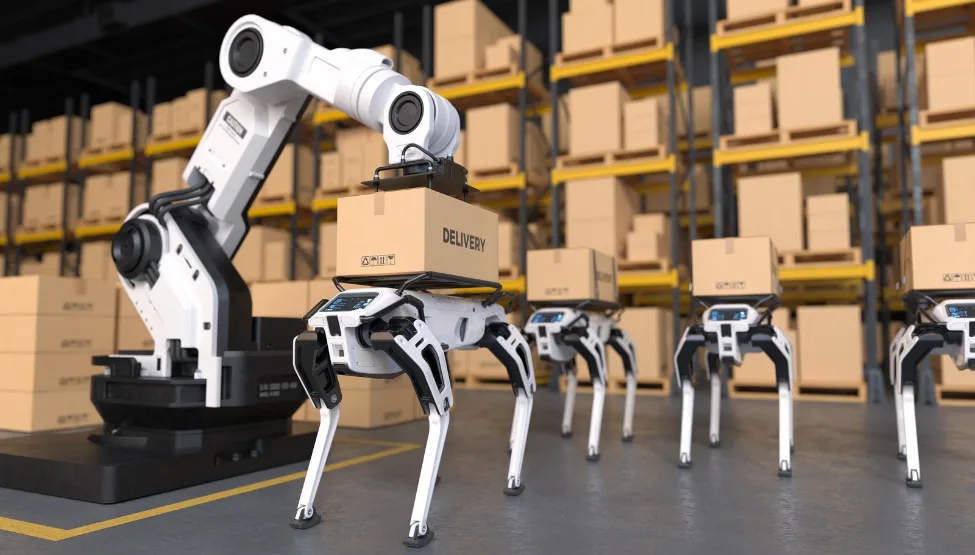
AI can already pilot digital processes. Now it’s taking over physical ones in the industrial manufacturing sector.
According to Capgemini, 79% of organizations are already engaging with physical AI in some capacity. And PwC analysts expect the technology to progress from early pilots towards scaled commercial deployment over the next 3 to 5 years.
So what can physical AI already effectively do in the industrial sector? In this post, we’ll look at the use cases and successful pilots. But first, let’s settle on the definitions.
Table of Contents
Understanding Physical AI
Physical AI is an umbrella term for technologies that allow machines to understand their surroundings, make decisions, and act accordingly. The term was originally coined by Jensen Huang, former CEO of Nvidia, to describe the company’s offerings. But it was later picked up by more players to represent the shift from machines that follow instructions to autonomous, context-aware systems.
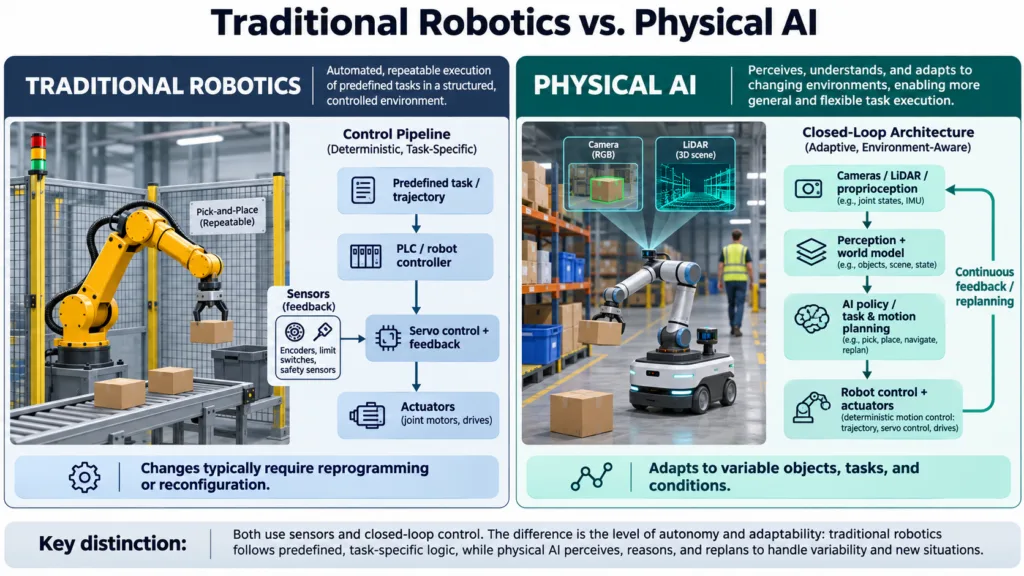
Advances in machine learning, deep learning, and reinforcement learning, coupled with physics-based simulations, gave way to a new generation of robots. Unlike traditional industrial robots that follow rigid, pre-programmed routines, the newer systems can better interpret context, adapt motion in real-time, and handle complex tasks with far less human programming.
Technologies Behind Physical AI
Physical AI relies on a mix of technologies that help machines make sense of their surroundings, make decisions, and act with greater autonomy:
- AI-powered perception and sensor fusion combine inputs from cameras, LiDAR, force sensors, and other devices to estimate a robot’s position and interpret its surroundings. Richer data improves object detection, collision avoidance, and real-time routing.
- Physics-based digital twins create virtual representations of actual work environments and robot dynamics. So you can test the robot’s behaviour and validate its performance with synthetic training data before bringing it to the shop floor.
- Robot learning and vision-language-action (VLA) models are responsible for skill acquisition. Reinforcement and imitation learning enable robots to learn behaviors through simulated interactions or demonstrations. VLA models extend this approach by translating visual observations and natural-language instructions into robot actions. So there’s less explicit task-by-task programming to do.
- Motion planning and adaptive control translate high-level decisions into executable robot movements. Planning algorithms calculate feasible trajectories, while feedback controllers continuously adjust motor commands based on sensor readings.
- Edge AI and real-time computing enable local data processing and commands, so there’s less latency. Local inference supports time-sensitive perception and planning, while dedicated real-time controllers handle functions requiring predictable response times.
Together, these technologies can create a continuous loop between perception, decision-making, and physical execution, as the next set of case studies will show.
6 Areas Where Physical AI Adds Value in Manufacturing
Physical AI is still at an early stage — and technological maturity varies considerably across applications. Many emerging capabilities have demonstrated promising results in controlled environments but have yet to prove their mettle on the factory floors.
Yet, the future potential is massive. McKinsey estimates that the physical AI ecosystem could unlock $1 trillion or more in economic value by 2035.
And even at the early stage, the next six physical AI use cases already illustrate the major future potential of these technologies.
Product Design and Prototyping
Industrial product development is highly iterative. Teams have to determine how different materials and product configurations will handle mechanical stress, heat, or fluid pressure. Each simulation comes with substantial time and monetary expenses.
Physical AI can accelerate the prototyping process with physics-informed machine learning models. Trained on historical engineering simulations, these algorithms learn to approximate physical behavior and generate accurate performance predictions. Combined with digital twins, they allow engineers to test more design variations at a fraction of the usual computational cost.
Hero MotoCorp used this approach for designing a new motorcycle handlebar. The team originally used finite element analysis (FEA) to predict structural stress. But with each simulation taking an hour, the team could only test so many designs.
So the company switched to Siemens Simcenter PhysicsAI — a pre-trained deep learning model for predicting structural behaviour based on previous simulation results. With the new platform, simulation time dropped to just three minutes, with only a 3% variation in results compared with conventional FEA. So the manufacturer could test and refine more configurations in less time.
German packaging equipment manufacturer Krones achieved similar gains. The company wanted to simulate liquid movement through filling lines under varying pressure and flow conditions to optimize efficiencies. Traditional CFD simulations took up to two hours apiece, dragging out design iterations.
To speed things up, Krones developed an AI-enabled digital twin combining GPU-accelerated fluid simulations with NVIDIA Omniverse. The new platform reduced simulation cycles to 10-15 minutes, giving engineers more flexibility to test equipment configurations and optimize liquid flow to reduce resource waste.
But the current shortcoming is high reliance on historical data. So their predictions may become less reliable when faced with unfamiliar designs or conditions. NIST explicitly calls for trustworthy, reliable operation and industrial data quality as continuing requirements for AI-enabled manufacturing. You shouldn’t skip physical testing either to validate results for safety-critical components.
Production and Assembly
Traditional robots excel at repetitive operations where every part arrives in a predictable position on the conveyor belt. Physical AI puts more variable tasks within automation’s reach. Computer vision and sensor fusion help robots identify objects and their positions, while AI-trained manipulation policies adjust movements based on what the robot sees.
For example, electronics manufacturer Foxconn recently deployed NVIDIA’s physical AI technologies to automate complex assembly tasks, including precision screw tightening and cable insertion.
The company developed its Fii Omniverse Digital Twin (FODT) platform to create physically accurate virtual replicas of its factories. Using NVIDIA Isaac Sim and Isaac Lab, engineers can simulate robotic assembly operations, while FoundationPose models estimate component positions and cuMotion generates collision-free robot trajectories. This setup allows Foxconn to test robot movements and optimize workcell layouts before deploying equipment on the factory floor, reducing physical trial-and-error.
Beyond assembly, Foxconn reports up to 150X faster computational fluid dynamics simulations using NVIDIA PhysicsNeMo. Thermal analysis now also takes minutes instead of hours. The company also estimates that virtual factory planning could reduce factory setup time by about 50%. Although this remains a projected benefit rather than a measured deployment result.
An even earlier-stage use case is using humanoid robots on active production lines. BMW just did a successful pilot at its Spartanburg plant, where Figure 02 robots were deployed to load sheet-metal components into welding fixtures The robo-team clocked over 1,250+ operating hours across regular 10-hour shifts and contributed to the manufacturing of over 30,000+ BMW X3 vehicles.
BMW subsequently tried the Figure 03 model too, which comes with better spoken command recognition and finer movement mechanics. The newer robot can adjust its movements when components are shifted, rotated, or partially obscured, including while repositioning its body to maintain balance.
Overall, conventional automation is extremely effective when product orientation, tooling, and sequence are tightly controlled. Physical AI becomes more interesting as variation increases — different part positions, occlusion, changed product mix, or manipulation while the robot itself moves.
Quality Assurance and Correction
Computer vision has already taken much of the legwork out of quality inspections. Physical AI can further augment the workflow with corrective action, allowing robots to remove defective products from production lines or perform adjustments. Edge AI also enables image processing directly on the factory floor, reducing the latency associated with sending visual data to the cloud.
ABB’s factory in Frosinone, Italy, is a great IRL example of the above.
The team recently deployed a new AI-powered inspection system, based on high-resolution cameras and a convolutional neural network (CNN), on industrial PCs. It can inspect each circuit breaker for scratches, dirt, or printing defects in under five seconds.
When it detects an anomaly, it sends a signal through a standardized API to trigger corrective action, such as diverting the defective unit from the production line. According to ABB, the automated inspection process has reduced manual inspection time by 20-40%.
General Motors went a step further, extending automation to physical repair. The computer vision part auto-detects paint imperfections. Then generates a repair trajectory, directing the robot to the affected area.
The robots then perform sanding and polishing operations while compensating for vehicle movement. This way, vehicles have higher finish consistency and reduce manual intervention in paint correction.
Meanwhile, Taiwanese electronics manufacturer Qisda uses ABB robots for component positioning, connection testing, and vision-based inspections. The company reported a 51% reduction in low-skilled manual tasks and a 52% increase in production per unit area following its adoption.
Overall, over 53% of manufacturers globally are adopting robots for quality improvement. But the remaining challenge is integration.
AI-generated inspection results must be fed back to industrial control systems, many of which still rely on legacy protocols. Likewise, defect classification must translate into safe, precisely timed actions by robots or PLCs, particularly on high-speed production lines. And delivering those signals with low latency is a difficult task.
Warehousing
Autonomous mobile robots (AMRs) are among the most mature applications of physical AI. About 59% of Interact Analysis survey respondents already use some form of such mobile automation, and 71% have automated part of their workflows with AMRs.
The big advantage of AMRs over traditional automated guided vehicles (AGVs) is that they can self-localize and adjust routes in real-time, based on the surrounding environment — e.g., foot traffic, new obstacles, etc. And this makes them more effective in busy warehouses.
Amazon, for example, uses a fleet of Proteus autonomous robots across its 25 US fulfillment centers. The compact yet mighty bot can transport weights up to 400kg across loading dock areas. The newer Proteus generation can also understand natural language commands, so employees could just tell it where to move and it will decide how best to execute the task.
Automotive OEM DENSO, in turn, uses AMRs for manufacturing logistics. At its Tennessee facility, employees previously walked up to 12 miles daily transporting components between the warehouse and production lines. DENSO introduced MiR250 mobile robots to automate these deliveries.
Using REST APIs, DENSO integrated the robots into existing workflows, allowing employees to request deliveries and the system to prioritize tasks automatically. To date, the robo-fleet has run over 500K successful missions, with the investment fully paying for itself within one year.
Effectively, these deployments show where warehouse robotics is heading: towards intelligent task orchestration. Most models can already navigate safely, but to deliver greater gains, AMRs also need to learn to determine which items should be moved next and self-coordinate assignments with other units. For that, AMR fleets will require better integration with warehouse management systems, production schedules, and fleet management software.
Asset Maintenance
Industrial asset inspections are no small feat, given the infrastructure size and the access restrictions. So manual checks are often time-consuming and expensive, not to mention downright hazardous.
Physical AI can take over some of those tasks. The new generation of ground robots and UAVs comes equipped with thermal cameras, acoustic sensors, and other monitoring devices for performing thorough inspections. Thanks to advanced navigation algorithms, they can traverse complex geometry to collect high-fidelity readings and identify structural anomalies.
When connected to asset management software or industrial foundation models, the collected intel enables more proactive repairs and predictive maintenance.
Swiss cement manufacturer Vigier Ciment is already testing this approach. Its production facility has over 1,000 rotating machines spread across multiple floors, some operating in extreme heat or difficult-to-access areas. Fixed sensors covered only part of the equipment, leaving technicians responsible for manual inspections.
To expand monitoring coverage, Vigier deployed ANYbotics’ four-legged ANYmal robot, equipped with thermal, acoustic, visual, and environmental sensors. Over 16 months, the robot completed 33,000+ inspections across 450 monitoring points, covering three mills on six floors.
During one inspection, it helped identify a cracked crusher foundation that could have caused a week-long production shutdown. In another case, thermal readings revealed a bearing overheating towards 140°C, allowing technicians to plan repairs before failure. In total, Vigier has avoided over 127 hours of downtime and $660,000 in estimated shutdown costs.
Belgian brewer AB InBev has achieved equally impressive results with Boston Dynamics’ Spot robot at its Leuven brewery. Spot does 1,800 inspections per week across 10 packaging lines, using thermal imaging to detect overheating equipment and acoustic sensors to identify compressed-air leaks.
In its first six months, it identified nearly 150 anomalies, including faulty motors and gearboxes requiring maintenance. More importantly, earlier detection helped reduce average repair times from several months to just 13 days.
The only downside is that modern inspection robots primarily collect and analyze operational data. Hence, maintenance decisions and physical repairs still depend on human technicians, making integration with existing maintenance management systems essential for converting detected anomalies into timely corrective action.
After-Sales
After-sales is one of the earliest stage use cases of physical AI because of the more challenging environment. Unlike new products arriving on assembly lines in neat stacks, returned goods can have damaged components, missing parts, or unrecognized wear.
So robots must be trained to recognize these variations and handle potentially fragile items with even greater care.
But advances in computer vision and force-sensitive robotic manipulation are making automated inspection and refurbishment more viable. Take it from a German electronics repair startup, Repartly.
The company refurbishes circuit boards from household appliances and processes thousands of electronic components monthly. To maintain its same-day repair service as volumes increased, Repartly introduced three ABB GoFa collaborative robots.
One cobot supports visual inspection and sorting, directing circuit boards towards manual repair or automated refurbishment. Two others remove defective components and solder replacements into place. With a 3-robot setup, Repartly reduced average processing time by 50%, from 20 to approximately 10 minutes per circuit board.
Assurant, in turn, used KUKA robots to automate mobile-device recovery at its Device Care Center. The facility employs 18 KR AGILUS industrial robots for device inspection and processing. AI-powered cameras assess cosmetic conditions. Force-torque control allows robots to connect phones to testing equipment without damaging their ports. AMRs also transport devices between processing stations, reducing manual handling throughout the refurbishment workflow.
With a greater degree of automation, Assurant can process over 160 million pre-owned devices annually, operating two months ahead of schedule even during busy periods.
Intelligent robotics can improve the economics of product refurbishment and support circular manufacturing. However, fully autonomous repair remains technically challenging. Variations in component condition and material degradation can require human diagnosis or specialized handling, particularly when repairs involve unfamiliar products.
Bringing Physical AI to Production Environments
Physical AI is finding its place across production floors — from faster product simulations and more flexible assembly lines to autonomous inspections and repairs. But many deployments remain at the proof-of-concept stage.
To gain the most value, companies will need to embed intelligent machines into the broader industrial ecosystem. Robots need reliable access to operational data, low-latency decision-making capabilities, and seamless integration with existing production, warehouse, and asset management systems.
At Edvantis, we help industrial companies build the software layer for supporting physical AI. We have experience establishing supporting infrastructure for robotics systems, deploying edge AI, computer vision, embedded software, and digital twins.
Talk to our team about your use case and the software capabilities needed to bring it to life.